What Is SEO? A Complete Guide to How SEO Works, Why It Matters, and How Businesses Can Grow Online in 2026
Every business owner wants more customers, more website traffic, and greater online visibility. But it’s not enough to be a website. Millions of websites compete for interest every day, making it increasingly difficult for potential customers to find agencies through search engines. Search engine optimisation plays an important role here. You will learn in this article from What is SEO basic to the advanced level.
At Krishna SEO Expert, we regularly meet business owners who have invested in a lovely website but wonder why it gets very few natural visitors. I personally cannot attract site visitors to a professionally designed website unless search engines take into account the content, evaluate the authority, and do not forget that it is valuable enough to recommend to users.
Search engine marketing is the process of making your website less complicated for every search engine like Google, Yahoo, and others. When implemented effectively, SEO helps your website appear for current searches, attracts qualified visitors, improves user enjoyment, and helps grow a sustainable commercial business without relying entirely on paid advertising.
The modern search engine market is no longer heavily prioritised for key phrases. Search engines came across as extremely clever. Google considers the first category of content, user enjoyment, overall performance, understandability, credibility, and relevance of the website before deciding what is worth seeing.
Meanwhile, AI-powered search experiences that include Google AI Overview, Google AI Mode, ChatGPT, Gemini, Claude, Confuse, and Microsoft Copilot are changing the way people discover information online. Businesses that post definitely helpful, well-placed, and trustworthy content are more likely to appear at the top of these evolving search results.
From our experience working with companies in certain industries, one aspect that remains consistent is that it is not about changing algorithms. It is designed to develop the best intelligent pleasure in your target audience while supporting engines like Google to comprehend your knowledge.
What Is SEO?
Simple Definition
SEO (Search Engine Optimisation) is the practice of improving websites so that they appear more prominently in search engine results when humans search for applicable products, services, or information.
The number one goal of SEO Expert is to attract acceptable natural visitors by making your website more useful, relevant, compelling, and technically accessible.
Unlike paid advertising, search engine marketing shows revenue visibility clearly over the years in terms of pay-per-click.
Professional Definition
From a business perspective, search engine optimisation is a continuous way of optimising website content, technical infrastructure, and user customisation to improve visibility across SERPs and AI-powered search engines.
Effective SEO involves several interconnected disciplines, including:
- Content strategy
- Keyword research
- On-page optimization
- Technical improvements
- Website performance
- Link building
- Local optimization
- Structured data
- User experience enhancement
- Continuous monitoring and improvement
Modern SEO is less about individual tactics and more about building a website that consistently delivers value to users.
Why SEO Exists
Search engines aim to provide users with the most relevant and reliable answers to their questions.
When someone searches for:
- “Best SEO expert in Bangalore”
- “Affordable accounting software”
- “Water purifier installation near me”
- “How does SEO work?”
Google evaluates thousands—or even millions—of pages before displaying results. Its goal is to recommend pages that best satisfy the user’s intent. SEO helps your website become one of those recommended results by demonstrating relevance, quality, and trust.
SEO Is About People First
One of the biggest misconceptions is that SEO is about pleasing search engines. In reality, modern SEO is centred on helping people. At Krishna SEO, we encourage businesses to think beyond rankings.
Ask yourself:
- Does this page genuinely answer the user’s question?
- Is the information accurate?
- Is it easy to read?
- Would someone trust this content?
- Does it solve a real problem?
When the answer is yes, you’re already aligning with the principles that search engines value.
How Does SEO Work?
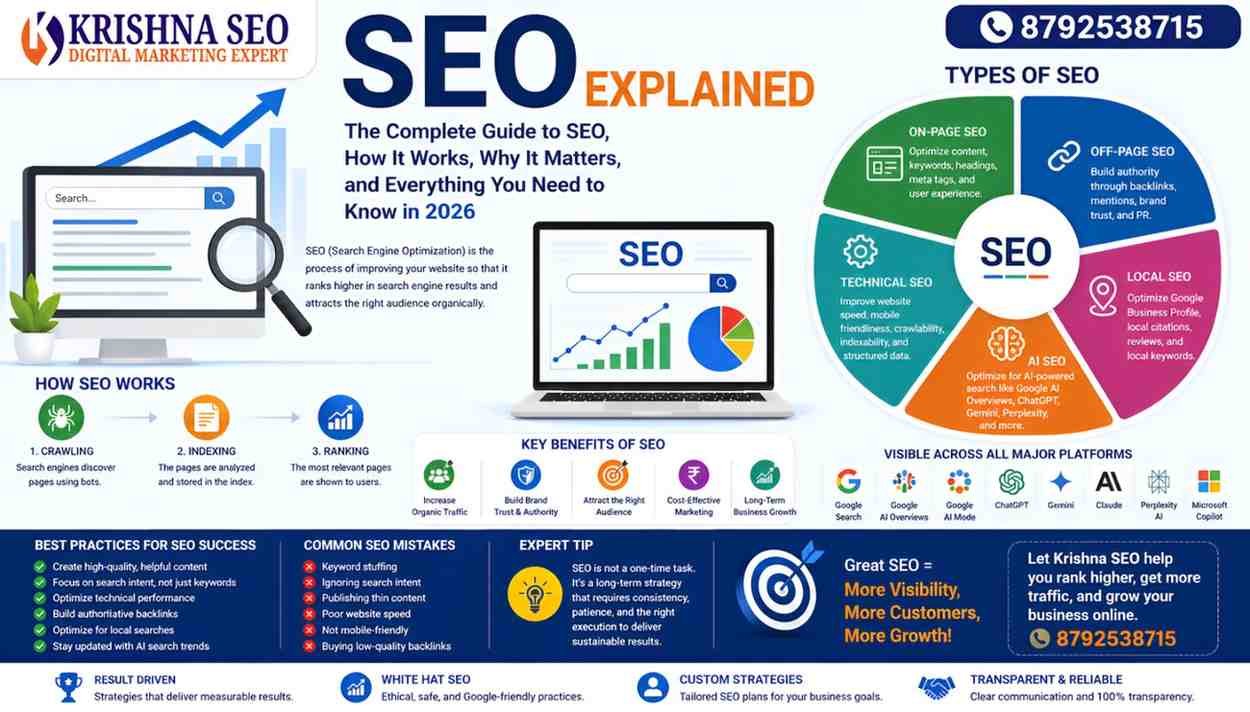
Understanding how SEO works becomes much easier when you know what happens after someone types a search query into Google. Although Google’s algorithms are incredibly sophisticated, the overall process can be simplified into three key stages:
1. Crawling
Search engines use automated programs called crawlers or bots to discover web pages across the internet. These bots follow links from one page to another, continuously exploring new and updated content. If your website is easy to navigate and technically sound, crawlers can efficiently access and understand your pages.
2. Indexing
After discovering a page, search engines analyse its content.
They evaluate elements such as:
- Page topic
- Content quality
- Keywords
- Images
- Internal links
- Page structure
- Mobile friendliness
- Loading speed
- Structured data
If the page meets quality standards, it is stored in Google’s index—a massive database of searchable web pages.
Pages that aren’t indexed cannot appear in search results.
3.Ranking
When a user performs a search, Google compares billions of indexed pages to determine which results best satisfy the query.
Ranking decisions consider hundreds of factors, including:
- Relevance
- Content depth
- Expertise
- Trustworthiness
- User experience
- Website authority
- Technical performance
- Freshness (when applicable)
- Search intent alignment
The objective is always to provide the most helpful answer—not simply the page with the most keywords.
How AI Is Changing Search
Search behaviour continues to evolve. Many users now seek answers through AI-powered experiences such as Google AI Overviews, Google AI Mode, ChatGPT, Gemini, Claude, Perplexity, and Microsoft Copilot.
These platforms prioritise content that is:
- Well-organized
- Accurate
- Easy to summarize
- Comprehensive
- Backed by expertise
- Focused on user intent
One thing we’ve consistently observed is that websites investing in high-quality educational content tend to adapt more effectively as search technology evolves.
Rather than optimising specifically for AI platforms, businesses should focus on publishing trustworthy, experience-driven content that answers real questions clearly and comprehensively.
Why Is SEO Important?
SEO is one of the most valuable long-term digital marketing investments because it helps businesses become discoverable at the exact moment people are searching for solutions.
Unlike interruptive advertising, it connects businesses with users who already have intent. Whether someone is researching a topic, comparing services, or looking for a local provider, appearing in those search results creates meaningful opportunities to build trust before the first conversation even begins.
1. SEO Increases Online Visibility
Every day, billions of searches are performed across Google and other search platforms. If your business is not visible when customers search for your products or services, those opportunities often go to competitors. It improves your chances of being found for relevant searches, increasing exposure to people who are actively looking for what you offer.
2. SEO Builds Trust and Credibility
Users naturally associate high-quality search results with trustworthy businesses.
Although ranking well does not automatically mean a business is the best, consistently publishing helpful, accurate, and well-structured content helps establish credibility over time.
From our experience, businesses that prioritise education over promotion often build stronger relationships with potential customers.
3. SEO Attracts Qualified Traffic
One of SEO’s greatest strengths is that it targets people based on intent.
For example:
- Someone searching “how to choose an accountant” is looking for guidance.
- Someone searching “SEO consultant near me” is likely evaluating service providers.
- Someone searching “buy CRM software” is closer to making a purchase.
This makes SEO an efficient way to attract visitors who are genuinely interested in your offerings.
4. SEO Supports Long-Term Growth
Unlike paid campaigns that stop generating traffic when the budget ends, well-optimised content can continue attracting visitors for months or even years. This doesn’t mean SEO is a one-time effort. Regular updates, technical improvements, and content refinement are essential. However, the long-term value of quality SEO often compounds over time.
5. SEO Enhances User Experience
Modern SEO encourages businesses to create websites that are:
- Faster
- Easier to navigate
- Mobile-friendly
- Secure
- Accessible
- Informative
These improvements benefit both search engines and users, leading to a better overall experience.
Is SEO worth it in 2026?
The short answer is yes – but it is much easier when approached strategically and with practical anticipation. Many business owners wonder whether or not search engine optimisation makes a difference, but as AI-powered search tools become more popular, it’s an honest question, especially as search research continues to support it.
From what we have observed, search engine marketing has not become less important. Instead, it has become more focused on exceptionalism, knowledge, and thorough utility.
Today, fulfilment is much less about following algorithms ideally and more about understanding your target audience, comprehensively answering their questions, and having a technically sound website.
Businesses that engage in search engine optimisation as an ongoing investment in education, users enjoy, and agree are generally ranked higher in line with eternity research in both traditional SERPs and AI-pushed search stories.
Another common hook is the timeline. Search engine optimisation is not an overnight answer. It takes consistency, patience and continuous development. However, companies that decide to publish valuable content and adhere to excessive website standards often create sustainable visibility that supports long-term growth.
In Krishna SEO, one of the things we say over and over again is that companies that focus on fixing customer problems instead of solely focusing on keywords generally tend to see stronger and more flexible effects over the years.
What are the different types of SEO?
SEO is not an unmarried hobby. It is a combination of several optimisation techniques that work together to improve website visibility, user delight, and authority.
One of the most common questions we hear from business owners is, “Which type of SEO should I focus on first?” The answer depends on your business goals, website maturity, and target audience. However, in our experience at Krishna SEO, the best results come when all major areas work together rather than in isolation.
Think of SEO like building a house:
- On-Page SEO is the interior design and content.
- Technical SEO is the foundation and structure.
- Off-Page SEO is your reputation in the neighbourhood.
- Local SEO helps nearby customers find you.
- AI SEO ensures your content is understandable and valuable for modern AI-powered search experiences.
Ignoring any one of these areas can limit your website’s overall performance.
What Is On-Page SEO?
On-Page SEO refers to everything you optimise within your website to help search engines understand your content and provide a better experience for visitors.
Many people assume On-Page SEO is simply adding keywords to a page. That approach may have worked years ago, but modern SEO is much more sophisticated.
Today, effective On-Page SEO is about answering user questions clearly, organising information logically, and ensuring every page delivers genuine value.
Key Elements of On-Page SEO
- High-quality, original content
- Proper keyword placement
- Optimised title tags
- Meta descriptions
- Heading hierarchy (H1, H2, H3)
- Image optimization
- Internal linking
- External references
- URL structure
- Readability
- User intent optimization
- Schema markup where appropriate
Example
Suppose you own a dental clinic in Bangalore.
Instead of creating a page titled:
“Dental Services”
A better optimised page could be:
“Affordable Root Canal Treatment in Bangalore – Complete Guide, Procedure & Cost”
The second example immediately communicates relevance to both users and search engines.
Our Experience
One thing we often notice is that businesses spend thousands on website design but very little on content quality. A visually attractive website cannot compensate for weak, outdated, or unhelpful content. Great SEO starts with genuinely helping your audience.
What Is Off-Page SEO?
Off-Page SEO includes activities performed outside your website that help build authority, credibility, and trust. Search engines evaluate whether other reputable websites mention, recommend, or link to your content. Think of Off-Page SEO as your online reputation. If respected websites consistently reference your content, Google gains confidence that your website provides value.
Common Off-Page SEO Activities
- Natural backlink acquisition
- Digital PR
- Brand mentions
- Guest articles
- Industry citations
- Local citations
- Business directory listings
- Social media visibility
- Podcast mentions
- Expert interviews
Why Backlinks Matter
Backlinks remain one of Google’s important ranking signals. However, quality always matters more than quantity. One link from a highly respected industry publication is generally more valuable than dozens of low-quality directory links.
Common Challenge We See
Many businesses still purchase backlinks because they believe more links automatically improve rankings. In reality, low-quality or manipulative link building can create long-term SEO risks. Instead, we recommend creating resources that naturally attract citations through usefulness.
What Is Technical SEO?
Technical SEO features to make your website easier for search engines like Google to crawl, find and index while giving users an exceptional browsing experience.
Unlike On-Page search engine marketing, Technical SEO is generally invisible to visitors. However, it has a significant impact on how search engines compare your website.
Important Technical SEO Factors
- Website speed
- Mobile responsiveness
- HTTPS security
- XML sitemap
- Robots.txt
- Crawlability
- Indexability
- Canonical URLs
- Structured data
- Core Web Vitals
- Broken link management
- Duplicate content prevention
Why Technical SEO Matters
Imagine writing an enjoyable article online. If Google can’t move or index fairly slowly, no one will find it through search. Technical search engine marketing guarantees you the opportunity to observe fantastic content.
Example: Even a slow-loading internet site can lose customers before the website even finishes loading. Improving loading speed benefits the individual experience and search visibility.
What Is Local SEO?
Local SEO helps businesses appear in searches that include geographical intent.
Examples include:
- SEO expert near me
- Best restaurant in Chennai
- Electrician in Bangalore
- Water purifier service nearby
These searches often have strong purchasing intent.
Important Local SEO Factors
- Google Business Profile optimization
- NAP consistency (Name, Address, Phone Number)
- Local citations
- Customer reviews
- Local landing pages
- Local keyword optimization
- Maps optimization
- Business categories
- Local backlinks
Example: A plumbing company serving only Bangalore should optimise for:
- Emergency plumber in Bangalore
- Plumbing services in Indiranagar
- Water leakage repair in Bangalore
Our Observation
We often see neighbourhood groups invest closely in social media and neglect Google Business Profile optimisation.
For many companies that are primarily carrier-based, nearby search, I personally generate more qualified leads than through social media because customers are actively trying to find solutions on the spot.
What is AI SEO?
AI Search Engine Optimisation is one of the fastest-growing areas of Search Engine Optimisation. Rather than just focusing on traditional search rankings, AI allows SEO companies to create content that can be understood, summarised, and displayed through AI-powered search stories.
These include:
- Google AI Overviews
- Google AI Mode
- ChatGPT
- Gemini
- Claude
- Perplexity
- Microsoft Copilot
- Bing AI
AI SEO is not about writing specifically for artificial intelligence. It is about creating content that is genuinely useful, well-structured, accurate, and easy to interpret.
Characteristics of AI-Friendly Content
- Clear definitions
- Logical heading structure
- Comprehensive topic coverage
- Accurate information
- Experience-based insights
- Helpful examples
- Entity-rich content
- Structured formatting
- Frequently Asked Questions
- Trustworthy sources
Why AI SEO Matters
Search is evolving rapidly. Users increasingly expect direct, conversational answers rather than browsing dozens of pages. Businesses that publish authoritative, well-organised content are more likely to remain visible across both traditional search engines and AI-powered search experiences.
What We Have Observed
The websites that perform well today generally have one thing in common:
- They prioritise helping people rather than chasing algorithms.
- That principle remains true whether someone discovers your business through Google Search, AI Overviews, ChatGPT, Gemini, Claude, Perplexity, or another search platform.
Common Search Engine Optimisation Mistakes to Avoid
SEO can provide long-term value, but even well-intentioned businesses often make mistakes that limit their impact. Many of these problems can be solved with the right technology and a focus on presenting the cost to customers.
At Krishna SEO, we often audit websites that have strong potential yet struggle due to a few common search engine marketing mistakes.
1. Focusing Only on Keywords
Years ago, repeating the same keyword more than once could improve your rankings. Today, this technique can make the content material harder to read and reduce its overall size.
Instead of keyword stuffing, focus on answering the user’s question definitively and in a timely manner. Use related clauses, units, and conversational language where appropriate.
2. Ignoring Search Intent
A site can be technically optimised and still fail if it doesn’t meet what users are actually looking for. For example, someone looking up “What is search engine optimisation?” Expect an educational guide – no longer a sales website. Understanding whether the search is informational, industrial, proximate, or transactional should influence how you organise your content.
3. Publishing Thin or Duplicate Content
One of the biggest demanding situations we see is websites with dozens of pages that offer little unique value. Each page should have a clear reason, and the contribution should do something worthwhile. Avoid copying content material from other websites or repeating the same statistics across multiple sites.
4. Neglecting Technical SEO
Technical issues can prevent even excellent content from performing well.
Common technical problems include:
- Slow page speed
- Broken internal links
- Duplicate URLs
- Missing XML sitemaps
- Poor mobile usability
- Indexing errors
Regular technical audits help identify and resolve these issues before they affect visibility.
5. Forgetting About User Experience
SEO and user experience go hand in hand. Visitors should be able to:
- Find information quickly
- Navigate the website easily
- Read content comfortably on any device
- Access pages that load quickly
- Complete important actions without confusion
When users have a positive experience, they are more likely to stay longer, explore additional pages, and return in the future.
6. Expecting Immediate Results
SEO is a long-term process.
Unlike paid marketing, results often take time because search engines like Google and Yahoo are slow to index and compare adjustments. Businesses that remain consistent in content creation, technical improvements, and individual-centric customisation are often in a higher position for sustainable momentum.
Suggested External References
When referencing external resources, choose authoritative and trustworthy sources. Some valuable options include:
- Google Search Central
- Google Search Quality Evaluator Guidelines
- Google PageSpeed Insights
- Google Lighthouse
- Schema.org
- W3C Web Standards
- Bing Webmaster Tools
- Google Business Profile Help Centre
These resources provide accurate technical guidance and help you stay informed about current best practices.
Recommended Images and Infographics
To enhance readability and engagement, consider adding:
- SEO Workflow Diagram – Crawling → Indexing → Ranking.
- Types of SEO Infographic – On-Page, Off-Page, Technical, Local, and AI SEO.
- SEO vs Paid Advertising Comparison Chart.
- Google Search to Customer Journey Illustration.
- Technical SEO Checklist Graphic.
- Local SEO Optimisation Process Diagram.
- AI Search Ecosystem Visual showing traditional search and AI-powered search experiences.
- SEO Pyramid highlighting content, technical foundation, authority, and user experience.
Visual content can improve understanding and make complex concepts easier to grasp.
Frequently Asked Questions
Q.What is SEO in simple words?
Ans: SEO (Search Engine Optimisation) is a system for improving websites that appear more prominently in search engine results when humans search for relevant facts, products or services.
Q.How long does SEO take to show results?
Ans: SEO is a long-term strategy. The timeline varies depending on factors such as competition, website quality, and industry. Continuous optimisation generally provides a greater long-term impact than short-term techniques.
Q.Is SEO better than paid advertising?
Ans: SEO and paid advertising serve different purposes. SEO has long had organic visibility, even as paid marketing promises immediate exposure. Many businesses can benefit from using each as part of a comprehensive virtual advertising and marketing strategy.
Q.Can I do SEO myself?
Ans: Yes. Many SEO fundamentals can be learned and implemented independently. However, aggressive industries or complex websites may have the added benefit of being handled by an experienced SEO expert.
Q.What is the most important type of SEO?
Ans: It’s not always a “most crucial” type. Effective SEO combines amazing content, technical optimisation, authority building, and, where relevant, neighbourhood optimisation. These elements add up to general performance growth.
Q.Does AI replace SEO?
Ans: No. As AI adjusts how humans search for and consume directories, it no longer eliminates the need for SEO. But businesses want accurate, simple, and well-defined content that satisfies the user’s reason.
Q.Why is local SEO important?
Ans: Local SEO makes it easier for businesses to connect with nearby customers who are actively trying to find services or products in a specific geographic area. It’s especially valuable for service-based, total, and proximity-based companies.
Q.How often should SEO content be updated?
Ans: Regular reviews help keep content accurate and current. Updating facts, reinforcing examples, and addressing emerging trends can keep your content useful over the years.
Why Choose Krishna SEO?
At Krishna SEO, we recognise that effective search engine optimisation begins with the expertise of your business dreams and the desires of your target market—not, of course, by chasing ratings.
Our technique is based on intelligent enjoyment, ceaseless study, and trust in the great traditions of the look engine. We are recognised for growing content; this is definitely useful, technically sound, and consistent with modern search traffic.
Whether you are a startup building your first website, a neighbourhood business looking to reach nearby customers, or a long-term business aiming to strengthen your online presence, we work to expand your search engine optimisation efforts as a long-term growth strategy.
Rather than counting on shortcuts or unrealistic promises, we prioritise sustainable optimisation, clean communication, and measurable improvements that support your core digital marketing goals.
Whether you are trying to improve the visibility of your website, attract more qualified traffic, or create a longer-term search engine marketing approach, Krishna SEO is right here to help you.
We can help with SEO audits, keyword research, technical search engine optimisation, local SEO, content strategy, AI SEO readiness, and continuous optimisation in line with your business dreams.
Whether you’re just starting your search engine optimisation adventure or refining your current strategy, our team is committed to providing sensible guidance and solutions to help you make the choices you need to make.
Ready to strengthen your online presence? Contact Krishna to discuss your business goals and explore an SEO approach designed for sustainable growth.